

BREAKING NEWS
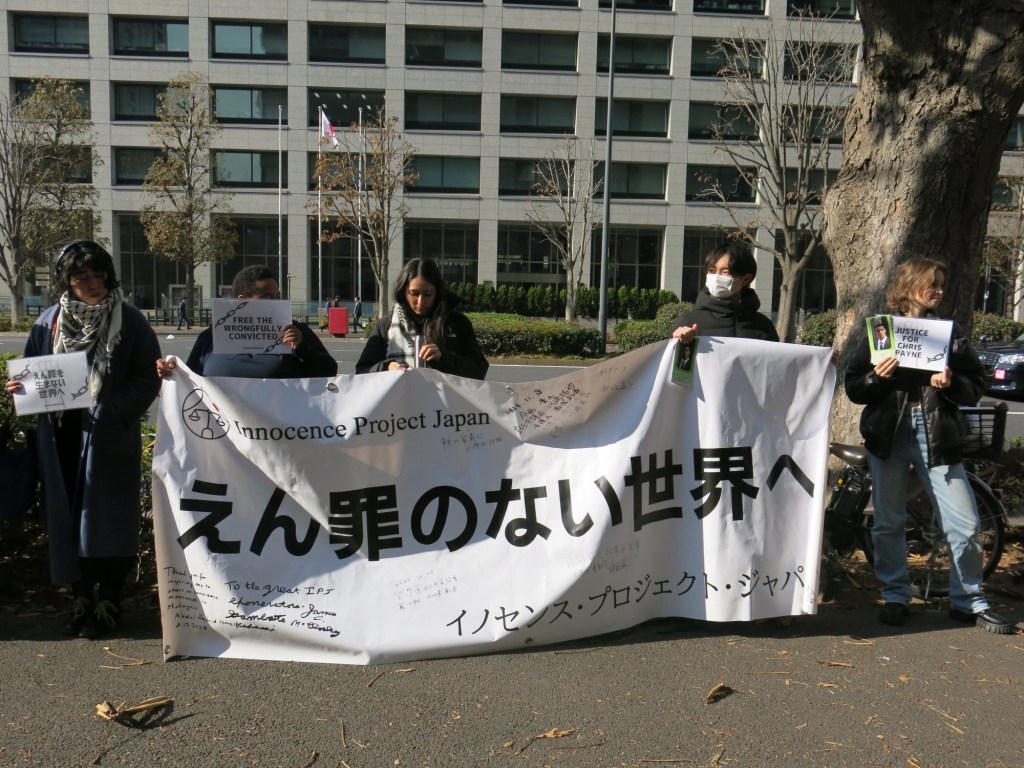
Supporters of Payne gather in protest in front of the Tokyo High Court, Kasumigaseki, Tokyo (JAPAN FOREIGN JOURNAL/The Myat Noe)
Updated on February 27, 2026

TOKYO — The Tokyo High Court ordered a re-trial on Thursday, bringing the Payne case back down to the Chiba District Court, and overturning its initial verdict.
Judges ruled that a decision could not yet be made regarding Professor Y’s analysis in light of the edits made by the analyst to the electropherograms.
Payne’s conviction stemmed largely from a disputed DNA analysis which the defense argued was flawed and unreliable. The ruling extends an almost four-year legal battle fought by Payne, his attorneys, and the Innocence Project Japan (IPJ), a case which has highlighted the complexities of using DNA evidence in criminal prosecutions.
The disputed analysis was conducted by Professor Y, a widely used DNA expert who has contributed to more than 1,000 police investigations, according to his university, and to 1,227 mostly criminal trials, according to Payne. Payne said in a letter that his attorney believes an acquittal could have broad implications for Japan’s justice system, saying that “thousands of lives [would] be affected.”
At a meeting held by the IPJ after the ruling, Payne’s legal team shared their thoughts regarding the High Court’s decision.
Tsunogae Kiyomi, who worked as a defense lawyer in the infamous Hakamada case, compared Payne’s case to Hakamada’s. Kiyomi said that judges ruled to overthrow an appeal by Hakamada’s defense, after DNA graphs were submitted in black and white, rather than in color. On these grounds, the court considered the defense’s DNA expert to be unreliable. Tsunogae considered this to be a “double standard” in Japan’s justice system.
Payne’s main lawyer claimed that judges were avoiding making a definitive ruling, given the implications of considering Professor Y’s analysis unreliable.
Two days after the ruling, Payne collapsed after a spike in his blood pressure, Percival told the Journal. On the morning of December 16, he “vomited a large amount of blood … and his nose has been consistently bleeding,” Percival wrote. According to the Number 1 Shimbun, Payne had to be subsequently restrained after becoming delusional and was taken to the detention center infirmary. Payne’s health has slowly improved since.
After the High Court’s ruling, Payne’s legal team submitted a bail petition on December 17 which was later rejected. Payne’s lawyers stated that his immigration status has been an issue for bail petitions, with his visa having already expired. In the rejected request, lawyers argued Payne did not pose a flight risk given that his passport was in the hands of the defense council, who vowed to keep it until the end of the trial. Lawyers wrote that the defendant also agreed to the installation of a GPS device in case bail were granted. Another request was submitted on January 15, this time citing Payne’s poor health and need for “proper medical care,” according to Percival. Rejected once again, Payne’s lawyers filed for a special appeal to this rejection to the Supreme Court, which later upheld the High Court’s denial, on February 24, Percival said.
Held in solitary confinement for over four years, Payne is set to be transferred to the Chiba Detention Center as he awaits for his retrial at the Chiba District Court, according to Percival.
His detention has drawn repeated human rights concerns, and Payne at one point described his treatment as “torture.” Japan has long been criticized for its practice of ‘hostage justice,’ in which suspects are detained for lengthy periods before trial. Human Rights Watch has said that the country’s criminal justice system “functions on laws, procedures, and practices that systematically violate the rights of the accused persons.”
The United Nations (UN) prohibits the use of solitary confinement for extended periods of time under the Nelson Mandela Rules, and a UN expert has said that its prolonged use “amounts to psychological torture,” according to the OHCHR.
“A better question to ask is what am I allowed to do,” Payne said, when asked what he was prohibited from doing in his cell at the Tokyo Detention Center. Payne told the Journal extensively about conditions and rules at the detention facility. According to Payne, inmates spend almost all day inside their cells, only being allowed to leave for showers thrice per week, and quick exercise sessions twice per week on some weeks.
Inside the cells, inmates are prohibited from laying down during most of the day, standing up without reason, or doing any type of physical exercise outside of the designated 15 minute periods that are announced twice per day. The lights remain on at all times inside the cells, and inmates have no view of the outside.
Non-lawyer visits cap out at one per day, limited to 20 minutes under guard supervision, where visitors can talk to inmates in either Japanese or English through a plexiglass screen with the use of a microphone. Letters can be sent by inmates, but they are only allowed seven pages and one envelope per day. Inmates can also only receive three books per day from the outside, and no food is allowed aside from a designated store in from of the Detention Center.
Ronda Terrill Payne, the defendant’s mother, spoke to the Journal about the United States (US) government’s support throughout the case. Ronda first contacted the State Department under the Biden-Harris administration in June of 2022, which marked the beginning of a process she described as “not easy.” After visiting Japan in January of 2023, Ronda received a letter from the State Department, who stated they were aware of her visit and of her son’s ongoing situation.
Under the Trump administration, Ronda sent another letter on December 16, this time highlighting her son’s health and need for medical attention. The State Department’s response, on December 31, stood out as irregular, describing the recent ruling as a “victory” for Payne, and misattributing the decision to the Supreme Court. The State Department’s communications have mainly stated awareness of Payne’s case, and spoken about the embassy’s work.
“The embassy has done the best they can,” said Ronda, who recognized the limitations the US embassy in Japan faces when it comes to domestic legal proceedings. According to Ronda, the embassy has been in continued contact with Payne, has remained updated on his situation and health, and has provided him with reading materials.
When speaking about her son’s case, Ronda considered it a symptom of a problematic system, claiming most in the US are unaware of what goes on in Japan’s courts and jails.


Leave a Reply