

Opinion and Analysis
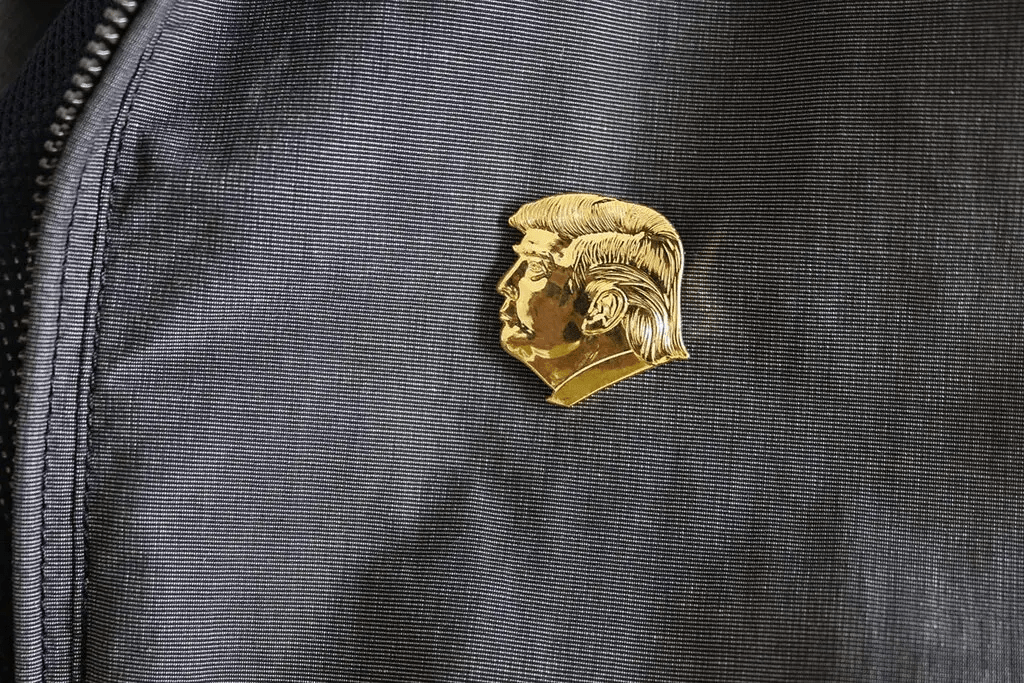
Golden lapel pin modeled on Donald Trump’s profile sold on Amazon, similar to one worn by FCC chair Brendan Carr (Amazon)

TOKYO — After Jimmy Kimmel’s show was indefinitely suspended by ABC on Sept. 17, questions have been raised about the current integrity of freedom of speech and its future in the United States.
The decision comes not as an arbitrary corporate call, but seemingly as a culmination of pressures from the Federal Communications Commission (FCC), as the chair of the agency threatened to pull ABC-affiliated licenses on Wednesday, according to CNN.
Despite the danger of such a blatant attack on freedom of speech, this development does not come with as much surprise as it should to most of us, but why is that?
Political scientists refer to it as “Democratic Backsliding”, and it is the process through which the integrity of democratic systems, institutions, and values, are gradually eroded in a transition towards authoritarianism. Scholars highlight that this process happens gradually and often slowly, like chipping away at a big rock, making it difficult to notice that each act is making your democracy less of a democracy.
Trump and his administration seem to be following this playbook ever since taking office, so let’s take a look back today at all the actions they have taken that undermine democracy, and try to understand how far the United States has come, and how much “democracy” is truly left in it.
What has taken place so far?
Democratic Backsliding is not just one institution falling, but rather an erosion of the interlocking system. Although democracy is a contested and complex concept, for today’s analysis we are going to take a look at six major pillars that generally make up democratic systems, and see how much each of them has been damaged by Trump and his administration.
1. Electoral Integrity
When one thinks of democracy this is probably the first one that comes to mind, and in fact free and fair elections are a central part of the democratic process. Although Trump hasn’t been found guilty of rigging or committing fraud in his past three presidential elections, the pillar of electoral integrity hasn’t been left completely untouched.
Up until May, President Trump repeated on multiple instances his will to run for a third term, an act strictly unconstitutional under the 22nd Amendment. Despite finally “ruling out” such an idea in a May interview with NBC, more concrete erosions have been made by his party.
As support for the GOP (Republican Party) decreases, Republicans in Texas passed a new congressional map essentially gerrymandering district lines to increase republican votes. In the short-term this will allow Trump to gain a tighter grip on the legislative branch by strengthening the Republican House majority. In the long-term the act not only questions the fairness of elections, but has also triggered a chain reaction in which many other states scramble to implement similar redistricting, according to ABC News.
2. Rule of Law and Checks on Power
Although the law and courts are responsible for keeping the power of the executive in check, Trump’s second presidency has enjoyed the privilege of a Supreme Court where six out of the nine judges were Republican appointed.
Even though judges are meant to be impartial in their judgement in spite of their personal beliefs, that may not be fully the case. Recent important pro-republican rulings on abortion, gun laws and election practices, have brought into question the Supreme Court’s ability to rule impartially. Such lack of unbiased ruling can prevent proper checks on power.
When courts do not rule in their favor, the Trump administration has consistently ignored or resisted court orders. In an analysis of 165 court orders by the Washington Post, the administration was found to have resisted at least 34%. This notably occurred in the case of Kilmar Abrego Garcia, unlawfully deported to a maximum security prison in El Salvador. According to The Independent, the administration initially ignored court orders to bring back Abrego. The government is now seeking to criminally prosecute him and/or deport him after his return to the United States, according to the Associated Press.
3. Civil Liberties and Freedoms
While other pillars are centered on politicians and judges, civil liberties and freedoms impact all of us first-hand. The Trump administration has taken several jabs at many of these, namely at freedom of speech.
The administration seemingly began by targeting more vulnerable groups, like immigrants. Rümeysa Öztürk, a PhD student at Tufts, was taken by Immigrations and Customs Enforcement (ICE) without due process back in March and was only released more than a month later after a court order, according to The Guardian. The Guardian also reported that the Trump administration had filed a deportation order against Öztürk, following an opinion piece she co-authored for a student newspaper criticizing her university’s response to pro-Palestinian demands.
Freedom of assembly rights have also been attacked. In another college campus, permanent US resident Mahmoud Khalil became a prominent figure in protests against the war in Gaza, which took place in Columbia University in 2024. This March, he was detained by ICE and held at an immigration facility for three months as part of a Trump administration crackdown on antisemitism, according to a BBC report. After a judge ordered his release back in June, another judge now ordered for his deportation, according to the same report.
More recently the free speech of American citizens came under attack. As stated previously, Jimmy Kimmel’s late-night show was indefinitely suspended, after a joke was made about Trump’s response to the murder of Charlie Kirk. The call seems to have been made due to a direct threat made by Brendan Carr, chair of the FCC, on conservative podcast, where he threatened to pull ABC-affiliated licenses, according to CNN. This incident is a gloomy show of political power in the restriction of lawful speech, as the chair of a federal agency designed to be independent and nonpartisan, successfully used his power to limit free speech, in a blatantly partisan manner.
4. Political Pluralism
Opposition rights and civil society autonomy are defining pillars, as without differing points of view a democracy ceases to be one. On the one hand, for all of the inflammatory remarks President Trump makes about his opponents, no significant legal restrictions have taken place to restrict political opposition. On the other hand, the autonomy of civil society has not been so lucky.
The Trump administration has taken on a fierce attack on the autonomy of higher education. Cutting funding and using it as leverage to control curriculums of universities across the country, as well as administrative decisions and regulations. A control of education by political parties to push narratives can be dangerous and threaten the plurality of opinions and views in the United States.
5. Informal Democratic Norms
Democracy can be defined into systems, institutions and regulations, but a strong democratic government should operate with democratic spirit. Informal democratic norms include mutual toleration, by which leaders and governments should treat rivals as political opponents rather than existential enemies. Throughout his presidency Trump has done the exact opposite, villainizing his opponents, and contributing to the deep polarization that divides the United States.
Institutional forbearance represents another of those informal norms. Through this principle, governments should respect the spirit, and not just the letter of the law. The Trump administration has failed to uphold it, extensively bending the law to achieve partisan goals. This tactic is evident in the case studies previously presented, in which laws and law enforcement have been used ambiguously to silence speech in promotion of party agenda.
6. Bureaucratic and Institutional Neutralities
When it comes to keeping politics out of institutions where it should not be in, the Trump administration has done a poor job. After being elected for his second term, Trump seemingly chose loyalty over talent, as he appointed a series of loyalists to “non-political” institutions. RFK Jr., known for unscientific takes on public health was made secretary of the Department of Health and Human Services. Kash Patel was appointed as director of the Federal Bureau of Investigation (FBI), despite never being an FBI agent. Brendan Carr, seen wearing a pin of Trump’s head instead of the American flag, which he proudly reposted on X, became the chair of the FCC, amongst other cases. Many raised concerns over the impact that these loyalist appointees might have on the state of the nation and democracy.
Surely enough, important programs saw their funding cut at the Center for Disease Control, according to the Wall Street Journal; in a recent House testimony, Kash Patel was “repeatedly evasive” when it came to President Trump’s proximity to the Epstein files, according to CNN; and Brendan Carr’s threat to pull ABC funding seemingly led to Jimmy Kimmel’s suspension, according to another CNN report.
Law enforcement has also been a target, as Trump’s politicization of ICE continues to strengthen. The administration has used federal law enforcement to carry out their mass deportation campaign, as well as pursuing discriminatory applications of the law, with the Supreme Court ruling yesterday that ICE is allowed to make use of racial profiling in immigration stops, according to the Boston Globe.
So how are the pillars holding up?
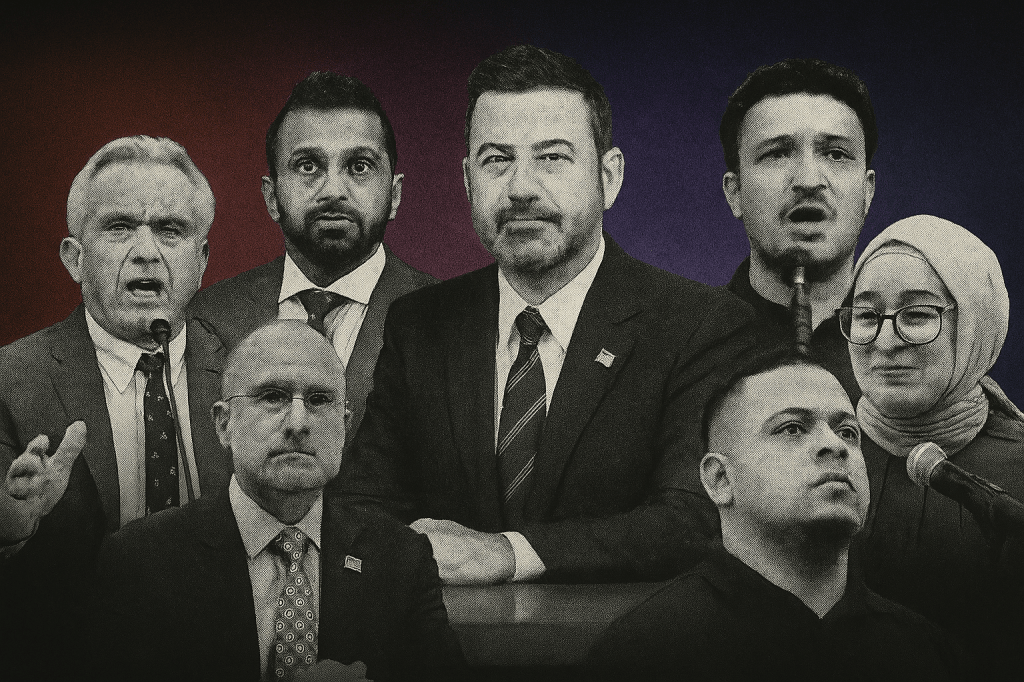
Newspaper style cut-out of (left to right) RFK Jr., Brendan Carr, Kash Patel, Jimmy Kimmel, Kilmar Abrego Garcia, Mahmoud Khalil, and Rümeysa Öztürk (Chat GPT/generated image)
From the length of the previous recap, it is clear that much has happened over the course of the second Trump administration. Each instance discussed represents a blow dealt against one of the “six pillars” of democracy. Looking back at a pre-2025 America, the country seems clearly less democratic, and its continual gradual erosion shows democratic backsliding at hand.
Electoral integrity seems to have been hit the least, while civil liberties, the rule of law and checks on power have taken significant blows. Although such attacks on integral liberties and systems are alarming in and of themselves, the fact that only eight months have passed since Trump has taken office raises questions about the future of the country. The U.S. ‘s vector of change seems clearly pointed towards authoritarianism, and the speed and magnitude at which these changes have been occurring paint a gloomy picture of future America.
It is important to point out that as it currently stands, the United States is still very much a democracy, under virtually all political science classifiers (such as Freedom House, V-Dem, and the Polity Project). Especially when compared to other countries classified as autocracies, residents of the United States still enjoy an array of freedoms, rights, and opportunities that many do not in other parts of the world.
Regardless of the direction it is heading in, the future of the country and its form of government are not written in stone yet. Only the future holds how much more the Trump administration will push the boundaries of democratic government, and how much more the American people and institutions are willing to give in to those attacks.
So far, this administration’s actions have shown how fragile democracy can truly be, and how easy it is to go against its norms, systems, and institutions. In the face of this worrying trend towards authoritarianism, the American people should grow to forgo partisanship to protect democratic norms and systems. To start, it is imperative they resist current attacks on democracy, regardless of what side of the political spectrum they may come from, because when democracy is damaged everyone bears consequence.
 Japan Foreign Journal | 日本国際ジャーナル
Leave a comment