
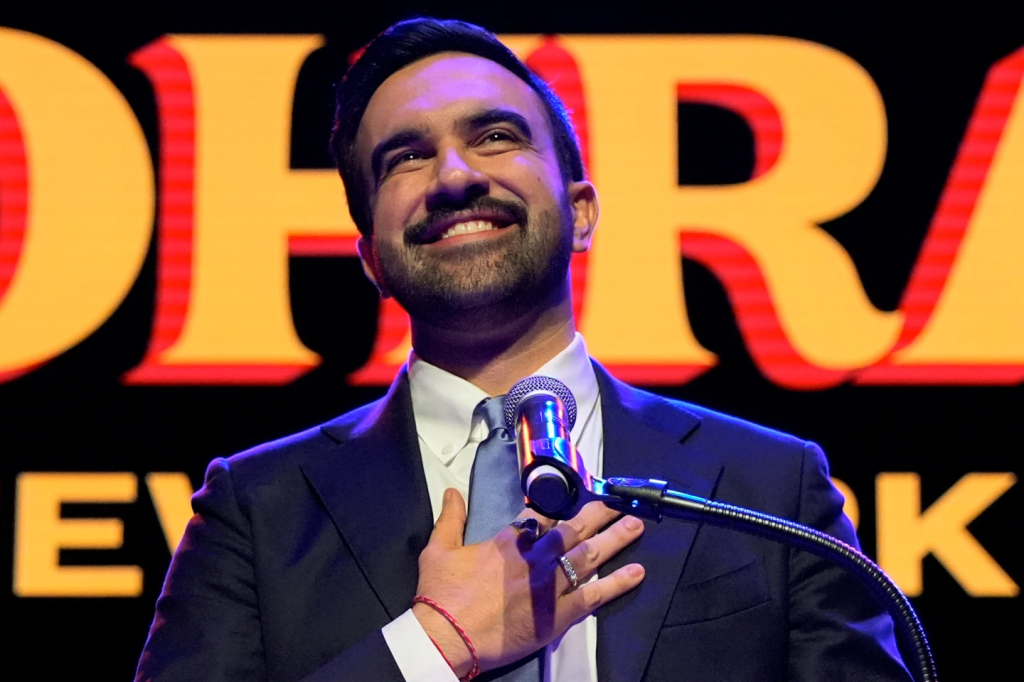
Zohran Mamdani speaks after winning the mayoral election, Tuesday, Nov. 4, 2025, in New York (AP Photo/Yuki Iwamura)

NEW YORK — Zohran Mamdani won the New York City mayoral race Tuesday, Nov. 4, defeating former Governor Andrew Cuomo and Republican Curtis Sliwa.
Taking office Jan. 1, 2026, Mamdani has pledged to deliver ambitious plans for the nation’s largest city, focusing on addressing the cost-of-living crisis and improving public safety through a range of policy initiatives.
As a young, progressive Democratic socialist, Zohran Mamdani made history as New York City’s youngest elected mayor in more than a century at age 34. Starting as a little-known state assemblymember with limited financial backing, Mamdani first won the Democratic primary for mayor in June with 56% of the vote, before quickly rising to prominence both in the United States and abroad.
Affordability was the centerpiece of Mamdani’s campaign. He has promised to make New York City more affordable by providing free childcare for children ages 6 weeks to 5 years old and offering faster, fare-free city bus services, according to Zohran’s campaign website.
Under former Mayor Eric Adams, rent for stabilized apartments increased by 12.6% over a four-year period, according to a Community Service Society report, making New York City more expensive for working-class residents and driving many out of the city. Mamdani has called this a crisis and plans to build new housing and lower rents.
Mamdani also proposed creating city-owned grocery stores with no profit motive, aiming to reduce food prices by redirecting city funds from corporate supermarkets to public stores.
Mamdani’s proposal also includes creating a new Department of Community Safety (DCS) to provide alternative responses to mental health crises through social workers. The DCS would be part of a broader public safety plan, operating separately from the traditional police department and focusing on mental health, homelessness and quality-of-life issues.
Following his political ideology, Mamdani has proposed a revised tax platform aimed at higher earners. According to his campaign site, this would include raising the corporate tax rate to 11.5%, and implementing a 2% tax on all incomes over $1 million. Although the campaign website claims the plan would raise $5 and $4 billion per year from each respective increase, Forbes points out that the campaign provides “no mathematical support” for this, and questions Mamdani’s jurisdiction to achieve such wide-scale changes.
While Mamdani’s proposals aim to make New York City more affordable, critics and opponents have called them “unrealistic”. Conservative commentators have described Mamdani as a “socialist menace” who would bring down America’s largest city, according to the BBC. Meanwhile, President Donald Trump labeled Mamdani a “communist” and urged New Yorkers to vote for Andrew Cuomo. According to Reuters, Trump threatened to withhold federal funds to the city if Mamdani won the race.
Mamdani also faces challenges over his socialist visions for New York City, with some fearing he could share the same fate as former Mayor Bill de Blasio. Sharing similar progressive goals, de Blasio left office in 2021 as one of the most unpopular mayors in the city’s history, according to the New York Magazine.
De Blasio vowed to combat growing inequality and advocated for marginalized communities. His main goals included ending income inequality, expanding free pre-K education, enacting worker protection laws for fast-food employees and reducing unfair police practices.
However, when policy met reality, de Blasio faced political and financial hurdles. His universal pre-K program, though ultimately successful, had to be funded by the state after Gov. Andrew Cuomo rejected his proposal to tax the wealthy to pay for it, according to a New York Times report.
Mamdani is expected to face similar obstacles. He will have to navigate the same financial constraints and conflicts with the Trump administration while raising significant revenue to fund his social projects.
Mamdani will also require the approval of New York Gov. Kathy Hochul to implement his proposed tax on the wealthy. Hochul has already signaled opposition to raising taxes under Mamdani’s plan. “I will say one energetic rally does not get me to change my positions. I assure you,” Hochul said on Fox News.
Forbes contributor Nathan Goldman wrote that taxing the rich could prompt millionaires to relocate, driving them out of New York City. He cited academic studies that examined the effects of so-called millionaire taxes.
“Wealthy taxpayers have the option to leave the city while still maintaining their work in the city itself. In fact, a very wealthy New York City resident potentially already owns real estate outside of the city. This potentially creates a situation where the taxpayer would be able to change their tax residence and avoid any incremental New York City taxes with minimal tax planning,” said Nathan Goldman.
However, a similar policy has already been implemented in Massachusetts. The state’s constitutional amendment, known as the Massachusetts Fair Share Amendment, was passed in 2022 and adds an extra 4% tax on annual income over $1 million, according to the Massachusetts Budget and Policy Center. The amendment has generated more than $2 billion in tax revenue to fund public education and transportation, according to The Boston Globe.
Shanique Rodriguez, executive director for The Massachusetts Voter Table, said, “This is further evidence that multi-millionaires are not fleeing the state in response to the new tax — they are staying here, paying more in taxes, and enjoying the stronger transportation and public education systems that Fair Share dollars are funding.”
The Fiscal Policy Institute, a New York–based nonprofit organization, published findings in March 2023 showing that even after the implementation of higher income tax rates for those earning more than $1 million, the state saw a 21.1% increase in its millionaire population.
New Jersey implemented a law in 2005 that raised the personal income tax rate by 2.6% for residents earning more than $500,000. While the state saw an out-migration of 37 millionaires, its overall millionaire population still grew by about 3,000 individuals, according to a Pathways Summer 2014 study.
As he begins his term on Jan. 1, all eyes turn to whether Mamdani can turn his progressive into results.
 Japan Foreign Journal | 日本国際ジャーナル