
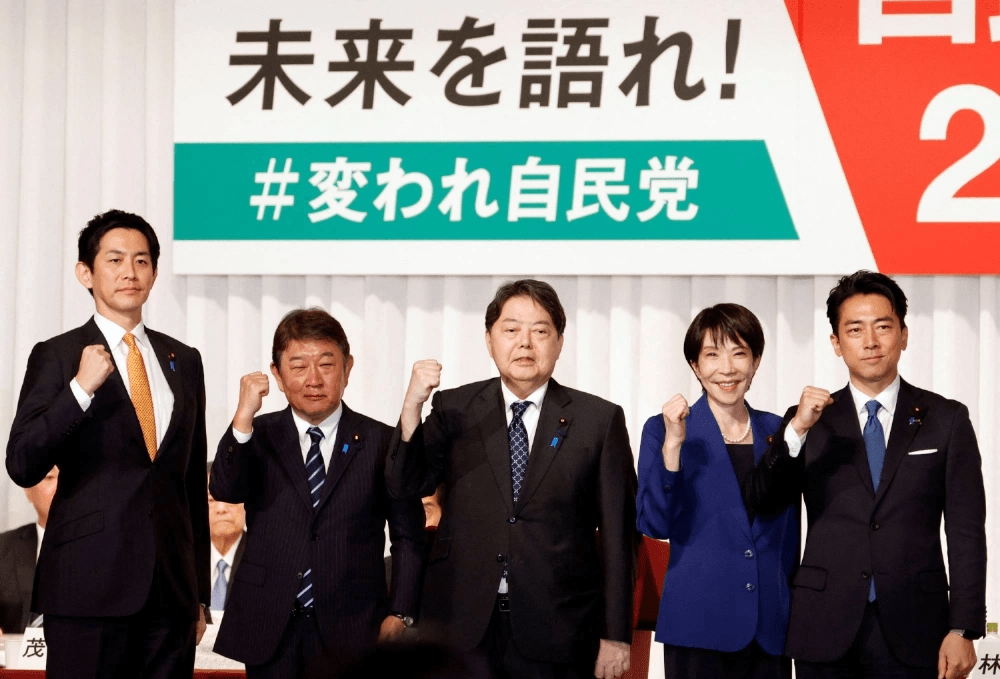
Former Economic Security Minister Takayuki Kobayashi, former Foreign Minister Toshimitsu Motegi, Chief Cabinet Secretary Yoshimasa Hayashi, former Internal Affairs Minister Sanae Takaichi and Agriculture Minister Shinjiro Koizumi pose after delivering speeches at the kickoff of campaigning for the Liberal Democratic Party presidential election on Monday, Tokyo (Reuters)

TOKYO — Japan’s ruling party opened official campaigning on Monday to elect the successor of outgoing Prime Minister Shigeru Ishiba.
Five candidates are competing to lead the Liberal Democratic Party (LDP) in an internal election taking place in early October.
The prime minister announced his resignation on Sept. 7, after a historic defeat for the ruling party and growing internal calls for Ishiba to take responsibility, according to the Associated Press.
This race, under the slogan “Change, LDP” (‘変われ自民党’), could mark a turning point for the party as it struggles to combat demographic changes, market problems, and international concerns. Support for the LDP and its coalition partner has decreased significantly in the past year according to the Japan Times, as they lost a majority in both houses of Parliament for the first time in party history.
Closed to the general public, the vote is set to take place Oct. 4, when 295 LDP parliamentarians and approximately 1 million dues-grassroots party members will elect the party’s new leader, according to the AP. The elected party leader will also need some opposition votes in a parliamentary leadership vote, in order to be elected as prime minister.
The five candidates
In a kickoff event on Monday, the five candidates delivered speeches, where they focused on the economy, stricter measures on immigration, and expressed willingness to work with opposition groups, the AP reported, something needed given the party lacks a majority in Parliament.
Shinjiro Koizumi: One of the top two contenders, Koizumi currently serves as agriculture minister and is known for his attempts to resolve the rice crisis. Steering away from divisive issues, Koizumi vowed to address public concerns on rising prices, growing foreign population, and public safety, ABC News reported.
Sanae Takaichi: The other top contender, Takaichi is a former internal affairs minister, and is known as a wartime history revisionist and China hawk. She supports higher military spending and paternalistic family values. Takaichi opposes a female emperor, and a revision to civil law to allow married couples to keep separate surnames.
Yoshimasa Hayashi: Chief Cabinet secretary of the current government, Hayashi is a political veteran who has served as education, foreign and defense minister in the past. Harvard-educated and member of a pop band, Hayashi promises steady wage increases, defense, and a strong economy, according to the AP.
Toshimitsu Motegi: Another party veteran, Motegi is known as a strong trade negotiator, having served as foreign and trade minister. Motegi emphasizes the importance of the Japan-U.S. alliance, and a deeper “relationship of trust” with Trump as central to Japan’s diplomacy, according to ABC News.
Takayuki Kobayashi: Kobayashi is an ultra-conservative and former economic security minister. Kobayashi promises strong growth, defense and national unity, as well as tougher restrictions for foreign workers, according to the AP. Calling defense spending targets insufficient, Kobayashi’s hawkish approach draws similarities with Takaichi’s, which could split the conservative vote.
The LDP’s historical dominance
Ever since its inception in 1955, the LDP has enjoyed a longstanding dominance in Japanese politics. The party has ruled the country nearly uninterrupted for 70 years, and the only times it was not in control were a ten-month period in 1993-94 and a three-year period in 2009-12.
Initially ruling alone, the LDP had to adapt to electoral reform and began ruling in coalitions in 1999. Since then, LDP-led coalitions were always able to form a majority in both houses of Parliament. This changed last year when they lost its majority in the lower house, and this year the same happened in the upper house. Such a loss may reflect a decrease in public trust for the LDP.
Prior to 2024, the LDP was long seen as a symbol of stability in Japan. While the world and the nation changed, the government did not, and the Japanese public entrusted the LDP with handling these changes.
With rising prices in a stagnant economy, a nationwide rice crisis, and growing concerns about immigration and international diplomacy, Japanese voters are beginning to blame the ruling party, rather than looking to it for help.
As the party’s reputation declines, who is elected leader can be a key factor in whether the LDP will be able to regain lost trust. Recent elections may indicate that LDP domination is in its final days, but it remains to be seen how this vote on Oct. 4 shapes the course of party politics in Japan.
 Japan Foreign Journal | 日本国際ジャーナル