
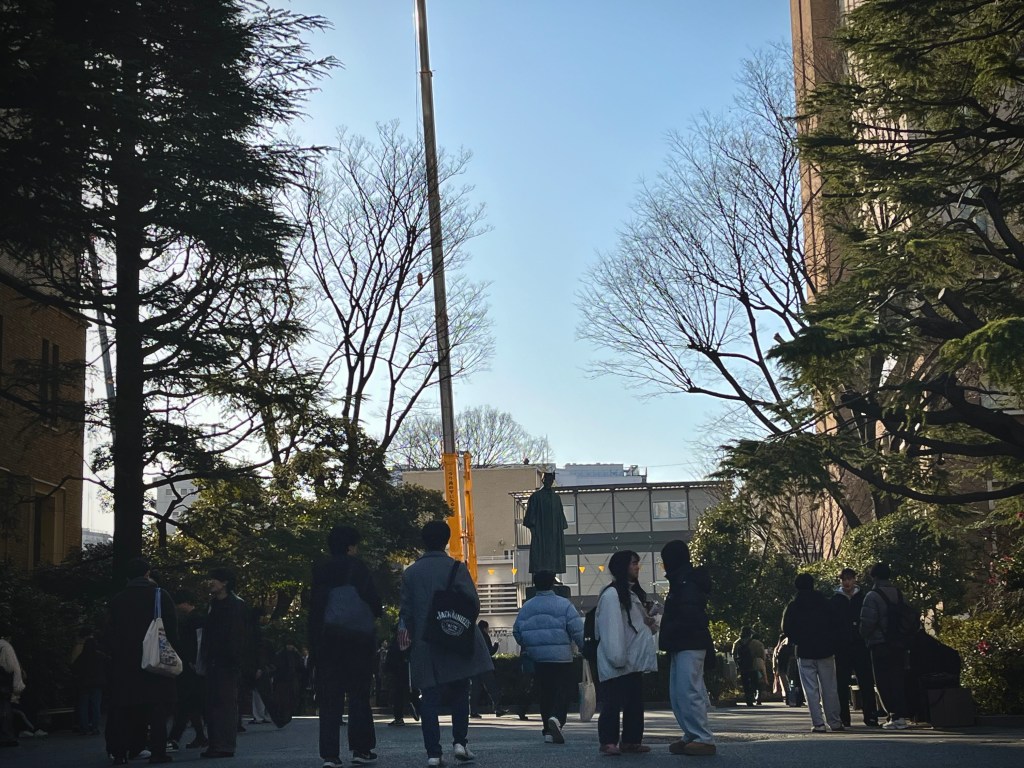
Waseda University’s Main Campus. Behind the statue of Waseda’s founder, Shigenobu Okuma, a new building for the Faculty of Education is seen currently under construction.

TOKYO — Three Japanese universities have announced plans to increase tuition fees for international students, citing increased costs of supporting them.
The announcements were made separately by three national research institutions, Tohoku, Hiroshima, and Tsukuba, throughout the months of December and January. Waseda, one of the country’s leading private universities, shared an internal announcement informing students that similar increases are being considered. Other national and private universities remain wary or opposed to such policies, and debate amongst faculty and students is ongoing regarding their potential impacts.
All four universities cited similar concerns in press releases and internal statements, arguing increased tuition fees would help cover the costs of international programs. According to the announcements, hiring of English-speaking staff, including professors, healthcare professionals, and administrative personnel, as well as construction of additional facilities have led to “significant expenditures.” Tohoku University stated it would increase tuition to 1.7 times the current wage, while Tsukuba stated a range between 1.27 and 2.1 times. Tsukuba also stated it would increase housing fees for international students.
“Without covering the costs, you cannot guarantee improved quality of education.”
– Senior Ministry of Education Official
Some institutions drew parallels with Western universities, which can charge fees several times larger than domestic ones for international students. Debate remains contentious, with discussions centering around Japan’s unique context, lack of financial aid programs, and concerns over diversity.
Enabling Policy
Regulated by the Ministry of Education, tuition fees for national universities are allowed to go up to a maximum amount, previously set to 642,960 yen per year. In March 2024, this cap was removed for international fees, following requests from Tohoku and other universities, according to the Asahi Shimbun.
After a change in over enrollment caps regarding international students took place, allowing universities to increase international student numbers, the ministry requested that those institutions raise international tuitions, Asahi Shimbun reported. A senior official at the ministry stated, “without covering the costs, you cannot guarantee improved quality of education,” according to Asahi Shimbun.
Universities were slow to formalize tuition increases, however, Tohoku’s announcement opened the floodgates as other institutions followed suit. The announcements also come at a time where Takaichi’s government pursues similar measures. December of 2025 was marked by several government announcements regarding significant increases in fees for visa applications and renewals. Similar to Tohoku’s rhetoric, the government’s public position reflects attempts to match Western countries’ “standards,” when it comes to immigration fees.
Many academic administrators oppose recent changes.
“We shouldn’t make a simplistic decision just because universities in the United States and Britain charge international students two or three times more,” said the president of a private university in an interview with Asahi.
The same report quoted a national university president’s criticism of the new requirements: “To achieve a multicultural society, it is necessary to treat everyone equally, regardless of their origin or cultural background. Tuition should not differ based on one’s place of origin or nationality.”
Waseda’s Case
Waseda University’s English-based degree programs are considered by many to be some of the country’s best. Interviews with students reveal both support for potential tuition increases, and concerns about student enrollment and fairness.
“International comparison matters,” said Keanu Jon Kanisch, an economics undergraduate student at Waseda University. “Japan can reasonably consider adopting a UK-style structure [, of creating a systemic split between ‘Home’ and ‘Overseas’ fees], while borrowing the US logic of protecting high-talent and low-income students through scholarships and wavers.”
Kanisch stressed that income structures can be a clarifying factor for understanding tuition increases. Private universities like Waseda rely heavily on tuition revenue to fund research, while public universities depend on larger public funding. He argued that overseas premiums could increase research capacity and educational quality in the case of private universities, while strengthening financial resilience in the case of public institutions. “This matters because research funding is inherently volatile — competitive grants and contracts fluctuate with macro conditions and policy priorities — so improving the stability of core funding can help sustain help sustain long-term, world-class research and training,” said Kanisch.
Several students told the journal that low tuition fees, significantly below US and UK numbers (which hover around the tens of thousands of dollars), were one if not the main reason for their choice of the institution. Some stated that reduced tuition costs provided them more financial flexibility, while others shared that higher prices would not be affordable.
Worries over student enrollment become evident when considering such factors. In regards to national universities, “charging international students the same sticker-price as domestic students effectively extends a taxpayer subsidy to people who do not contribute to that tax base, which can be seen as unfair to Japanese students competing for limited seats and whose families finance the system,” said Kanisch in response to arguments that international fees should not be raised to maintain higher levels of international enrollment. Others argued a trade-off was needed in this aspect, in order to maintain cultural and intellectual diversity.
In its internal communication, Waseda’s president, Aiji Tanaka, marked a point of divergence from other universities’ stance. In line with Tohoku, increased costs due to language-barrier related issues were quoted as a reason for potential tuition increases. However, Tanaka identified “students who have not learned Japanese” as the target of potential increases, instead of international students as a whole. What level of Japanese proficiency would be required for exemption was not stated.
The university’s decision on whether or not to raise costs has not yet been reached, and Tanaka added that currently enrolled students would not be affected if the university decides to move forward with any changes.
 Japan Foreign Journal | 日本国際ジャーナル