
Analysis
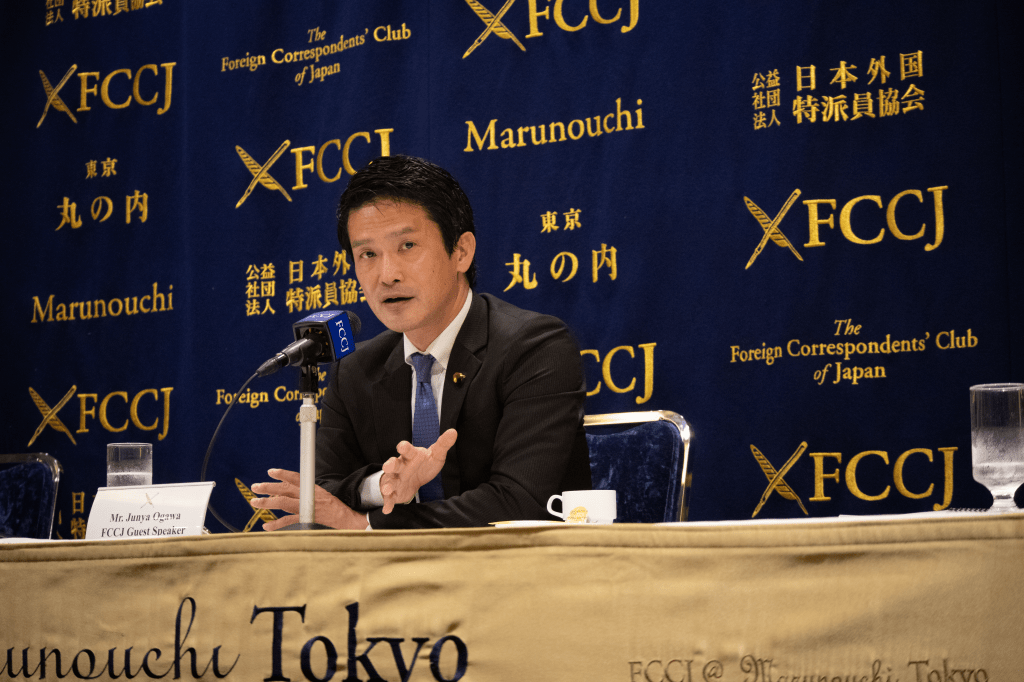
Junya Ogawa, leader of the Centrist Reform Alliance, speaks at an FCCJ press conference in Marunouchi, Tokyo, on April 22, 2026 (Federico Duarte/Japan Foreign Journal)
Junya Ogawa’s new opposition alliance is trying to prepare Japan for demographic decline. But voters may want a party that promises to reverse it.

Writer and Editor
TOKYO — Japan’s opposition alliance faces a defining test as Prime Minister Sanae Takaichi revives the ruling Liberal Democratic Party’s standing with voters.
February’s lower house election dealt a heavy blow to Japan’s new opposition alliance. While Takaichi managed to secure a firm majority, the Centrist Reform Alliance won just 49 seats. Formed in January ahead of the snap election, the CRA was left with less than a third of its lower house strength once held by its constituent parties.
An unlikely merger between Komeito — the LDP’s former coalition partner of 26 years — and the left-leaning Constitutional Democratic Party, the CRA faces steep challenges. With Takaichi still popular and the alliance under internal strain, the central question is whether the CRA’s leadership can rebuild support.
Will the CRA be able to regain electoral support? Or will Japan’s opposition fall into another era of LDP domination?
A Struggling CRA
Beyond its reduced seat count, the CRA faces internal divisions that could implicate its path forward.
Adopting a split electoral strategy, the CRA fielded mostly CDP candidates in district races and Komeito candidates in proportional representation. The result was uneven losses between the two candidates.
CDP lawmakers won 21 seats, down from 144 before the election, while Komeito won 28, up from 21. The day after the election, co-presidents Yoshihiko Noda and Natsuo Saito resigned. They were succeeded by Junya Ogawa, the former CDP secretary-general, who now faces the task of uniting the parties and rebuilding the alliance.
“I am proud to have achieved forward-looking cooperation between Komeito and CDP members,” Ogawa said at an April press conference at the Foreign Correspondent’s Club of Japan, referring to the CDA’s first three months. He nonetheless described the relationship between the two parties as “complex.”
Ogawa also acknowledged the CRA’s “challenging position” in the legislature, saying he has been unable to achieve many of the alliance’s goals.
Post-election analysis points to a significant generational and partisan leakage problem. ANN exit-poll data suggests that CRA support skewed older, as younger former CDP voters shifted to the LDP. Asahi exit polling shows that only about 60% to 70% of previous CDP voters backed the CRA, compared to almost 80% among Komeito voters.”
“Expanding redistribution as social investment,” is how Ogawa outlined his plan. When asked how he would win back young voters, he pointed to increased investment in areas like job-training, marriage support, and childcare, aimed at the working-age generation.
The Demographic Squeeze
Japan’s demographic pressures are a visible issue. The fertility rate is already below replacement levels, people 65 and older make up 29% of the population, and social security accounts for roughly a third of the national budget. Long-term projections paint a harsher picture for the country.
A labor crisis also looms. By 2050, Japan is projected to have 79 people aged 65 or older for every 100 people aged 20 to 64, according to the OECD. This demographic squeeze would intensify pressure on workers, public finances and the social security system, as a growing elderly population is supported by fewer and fewer workers.
Marriage and birthrates remain in long-term decline, despite the government committing more than 3.6 trillion yen to child-rearing and demographic measures, alongside billions more in local marriage-support grants, AI matchmaking programs, “life design” campaigns, and newlywed subsidies.
“We believe the declining births has not been effectively controlled,” Chief Cabinet Secretary Yoshimasa Hayashi said at a news conference in February 2025. Accoring to the AP, he added that the government would “steadily pursue expanded childcare programs and subsidies for childrearing households, while promoting salary increase and support for matchmaking effort.”
Additional spending alone may have limited effects, internal policy estimates suggest. Cabinet office materials estimate that a 5 trillion yen increase in support could lift fertility rates up only 0.05 to 0.1 points.
The failure of current measures, combined with poor cost-benefit projections, points to a broader strategy problem. Deeper issues — including Japan’s stalled gender revolution, career penalties tied to pregnancy and motherhood, and traditional family norms — reamain major barriers. For many young people, these pressures make marriage and childbearing feel like a gamble. The problem for them is no longer merely financial; it also implicates carreer opportunities and long-term work-life balance.
Japan needs a different strategy; does the CRA hold the key?
Ogawa’s Vision
Ogawa has placed Japan’s demographic crisis at the center of the CRA’s agenda. At the FCCJ press conference, he framed the alliance’s task around one central question: how Japan can maintain its economy and welfare system as its population shrinks and ages.
His answer rests on several themes: protecting the pension and welfare systems, pursuing systemic change rather than minor policy adjustments, expanding domestic control over food and energy supplies, and using restructuring and redistribution to modernize Japan’s political economy.
In its basic policy platform, the CRA calls for “correcting the excessive depreciation of the yen and lowering prices of essential goods such as food and energy.” It also proposes a “new social security model,” including a government-backed fund to eliminate consumption tax on food products and reduce burdens caused by social insurance premiums. The platform also calls for “the introduction of a ‘refundable tax credit system’ to alleviate the burden on low- and middle-income earners and correct inequality,” alomg with preventive medicine and “enhancing the well-being of the public.”
Is Economic Growth the Solution?
Ogawa and the CRA want to prepare Japan’s society and economy for the demographic pressures ahead. Their strategy is less about reversing demographic change than making the country more resilient to it.
Economic resilience and financial prosperity could ease the burden of an aging population, but such a strategy is without its risks. Japan’s demographic squeeze is tightening quickly, meaning workers would need significantly greater financial leeway — through higher wages, a stronger yen or a lower cost of living — for the strategy to succeed.
South Korea offers a warning. With a GDP per capita of about $36,239 in 2024, the country has not been shielded from demographic pressure. The OECD says South Korea’s fertility rate has fallen from 1.7 to 0.7 over the past 30 years, while its population aged 20 to 64 is projected to halve by 2064. Its old-age dependency ratio is also projected to rise sharply, creating a heavier aging burden than Japan’s.
This pressure is already affecting welfare policy. In 2025, pension reforms were passed as South Korea’s public pension fund had been on track to run out by the mid-2050s due to rapid aging, according to Reuters.
A similar gap appears in the CRA’s platform: its policy goals are ambitious, but its funding remains vague. Government-backed funds and tax cuts require new or redirected revenue. Although Ogawa has emphasized “redistribution” as a tool, he has not explained in detail how it would be funded.
By contrast, New York City Mayor Zohran Mamdani campaigned on economic restructuring and welfare, while tying those promises to specific revenue-raising proposals such as higher taxation of millionaires and large corporations. The CRA has not been clear about funding mechanisms, making its redistribution agenda appear less developed.
Why the LDP?
The CRA’s focus on social security and cost alleviation addresses the burden of Japan’s demographic crisis, but it may not answer the voters’ demand for action against population decline itself.
Although it has not succeeded in reversing population decline, the LDP sends a clear message: Japan should not only adapt to a shrinking population, but also try to reverse this trend. “A silent emergency,” were the words of Takaichi in her February policy speech, when referring to population and birthrate decline. She also stated that her government would pursue a strategy of both reversal, and adaptation.
Cabinet Office surveys suggest voters care about both sides of the issue. An August 2024 survey showed that 64.6% of voters think the government should focus on improving medical care, pensions and social security — goals explicit in the CRA’s platform. But 52.2% also named “measures for an aging society,” while 39.0% named “measures against the declining birthrate.”
In a more direct Cabinet Office survey, 41.1% said the government should strongly work to stop population decline, while 34.3% said it should act while respecting individual reproductive choices. Combined, 75.4% supported some form of government action.
That creates a strategic problem for the CRA. If voters see the centrist alliance as bracing for an inevitable crisis, it may be difficult to compete with the incumbent party, whose message reflects a promise of both protection and action. This may help explain why many voters turned to the LDP — and why the CRA could remain in a vulnerable position without a more direct demographic strategy.

